Virtual Bruges in 3D: walk the town of 1562
Bruges 1562 is a virtual Bruges that you walk through freely in your browser: the town as it stood in 1562, rebuilt in 3D street by street from sources. You go where you like, at eye height, and you need no VR headset and nothing to install. It is free.
A whole town, not a row of photographs
Many virtual tours of a town are made of 360° photographs. You stand on a fixed spot, look round, and jump to the next spot. Others are films for a VR headset that take you along a route someone else chose. Bruges 1562 works another way. The whole town is built in 3D, so you walk where you like: you turn into any side street, cross any bridge, go up to a church door and stop wherever you want. Nothing is filmed. Your computer draws the city as you move through it, in morning fog, in the afternoon sun or in the evening light.
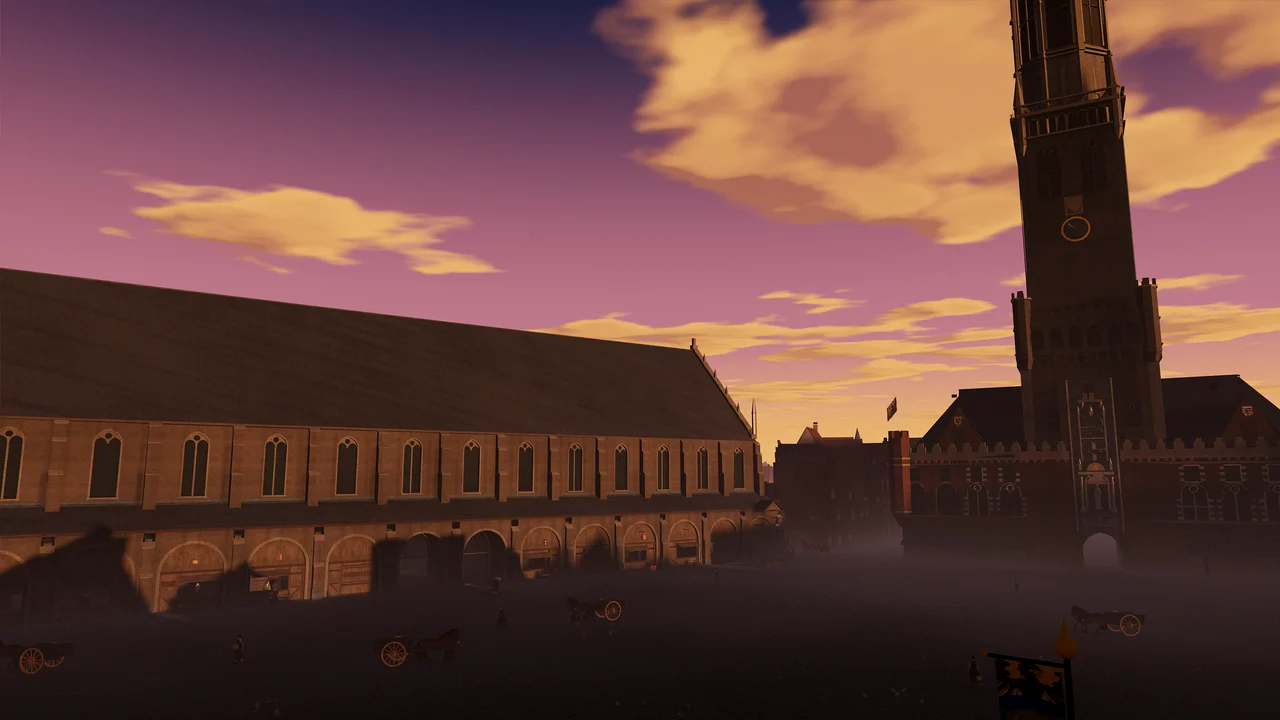
And it is not the Bruges of today. A photo tour shows the town as it is now, with its later fronts and its nineteenth-century buildings. Bruges 1562 shows the town of the summer of 1562. The Waterhalle still spans the canal on the east side of the Markt, Sint-Donaas still stands on the Burg as the new cathedral, and the great crane still lifts casks on its quay. Buildings that were pulled down centuries ago stand again where they stood. The guide to the lost buildings of Bruges tells what became of them.
What is open to walk
Open now is the heart of the town inside the first city wall: about 68 hectares, with 147 named streets and quays, 2,772 houses on their real plots and 133 landmarks. It takes in the Markt, the Burg, the Dijver, Sint-Salvator, Onze-Lieve-Vrouw, Sint-Jakob, the Prinsenhof and the port at the Kraan. The rest of the city is being built, quarter by quarter, out to the ramparts and the gates. The list of buildings shows every landmark that stands in it.
What you can do in it
- Walk every street of the open part at eye height, and go into the churches, the inns and several halls. Many other buildings are still closed for now.
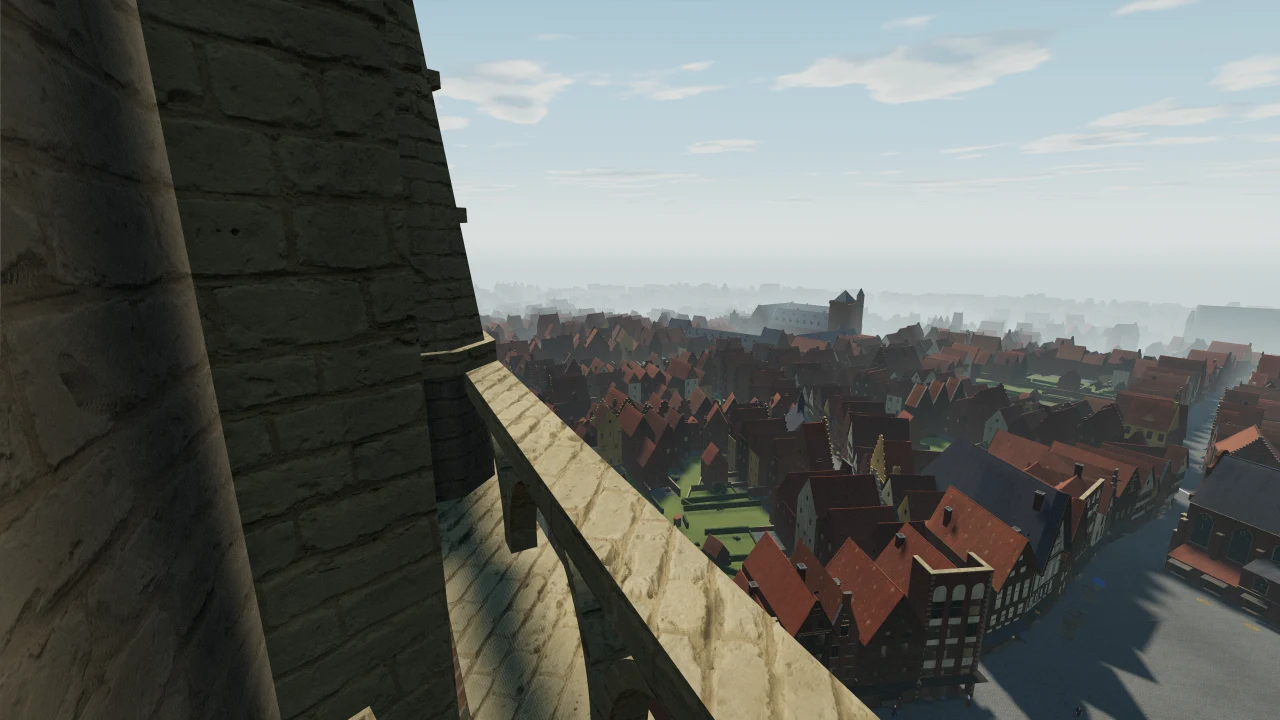
- Climb six towers: the belfry, the towers of Onze-Lieve-Vrouw, Sint-Salvator, Sint-Jakob and the old Sint-Walburga, and the tower of the Poortersloge. Their heights come from the laser survey of Flanders, so the view from the top is the real one, with the roofs of 1562 below you.
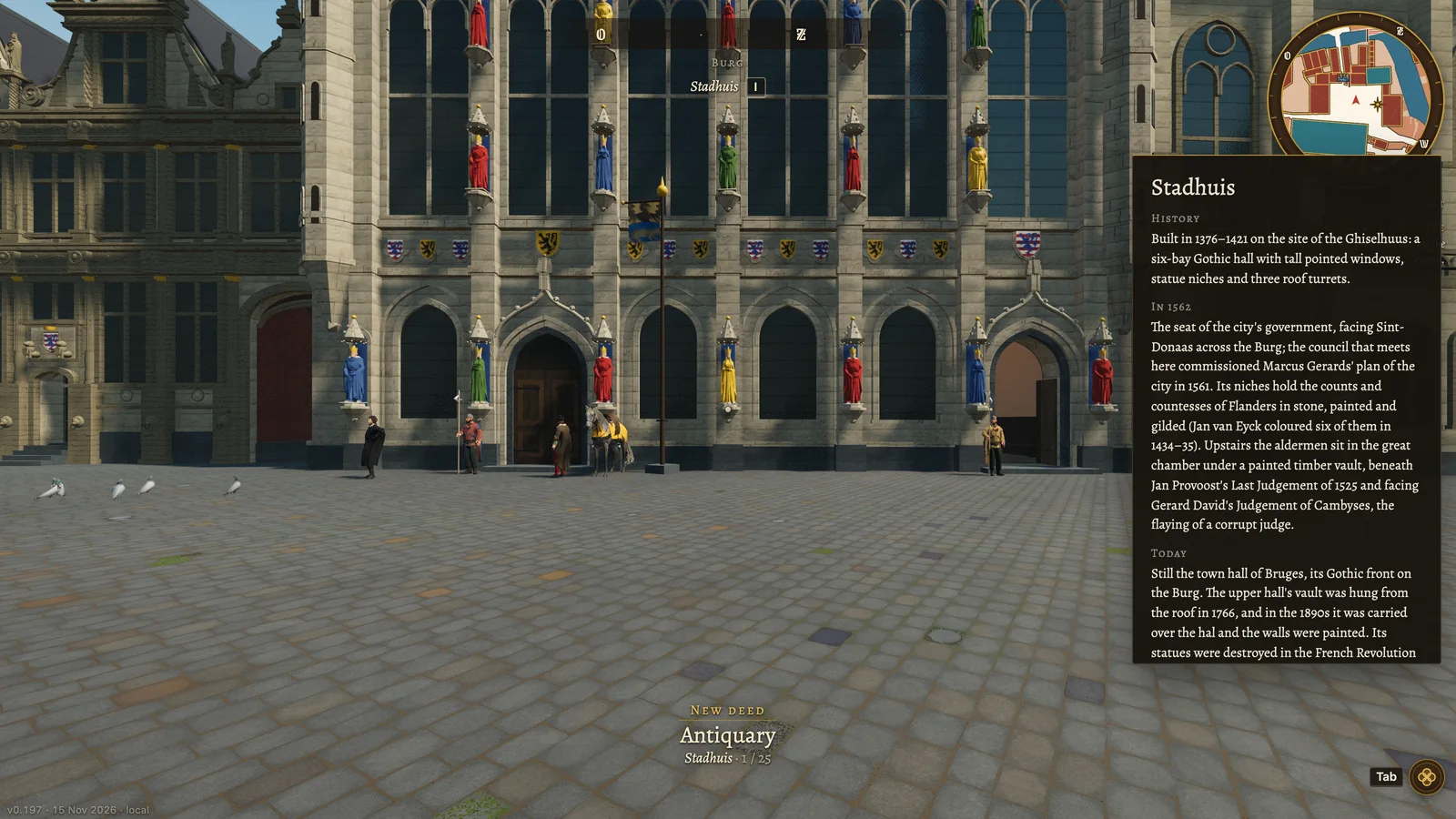
- Read the history card of each of the 133 landmarks (I): how it came to be, how it stood in 1562 and what became of it.
- Open the map (M) with every street under its name. Set a mark on it and the compass points the way.
- Ride a post horse between the squares, pole a boat along the canals, or let the water taxi carry you.
- Play Book I of the story, Home to Bruges: 16 chapters set in the summer of 1562, each built round one true thing of that year. Nothing forces you to follow it: you can also just walk.
- Fill the deed log with the squares you stood on, the towers you climbed and the cats you found in the narrow lanes, and rise in rank from Stranger to Headman.
Built from sources, and honest about the guesses
Every street, canal and house plot lies where it lay. The streets and plots come from the surveyed map, because most of them have not moved in five centuries, and the level of the ground and the heights of the landmarks come from the laser survey of Flanders. Each landmark stands on its outline from the heritage inventory, and whatever was added after 1562 is left off. Every historical statement is an entry in a ledger, and the ledger cites 766 sources.
Where the sources stop, the town says so. The fronts of ordinary houses are typical of the period and are not portraits of the houses that stood there. Interiors, colours and the people in the street are mostly careful guesses, and the story is fiction. The page about the reconstruction explains the method, and the guides to Bruges in 1562, medieval Bruges and the map of Marcus Gerards give the history behind it.
No headset, nothing to install
Bruges 1562 opens in a web browser on a computer with Chrome or Edge. You need no VR headset and no app: a keyboard and a mouse or trackpad are enough, and you look round with the mouse as you walk with the keys. The city is drawn with WebGPU, a recent way for a browser to use the graphics chip. The download is about 85 MB and the first load takes around 40 seconds on a recent laptop; later visits are quicker. Phones, tablets and Safari cannot open it yet. The help page says which computers work and lists the keys. The city itself is in Dutch, English and French.
How to get in
Bruges 1562 is free. It opens with an access code: put your name on the waiting list and a code comes to you by mail. As a guest you walk the Markt, the Burg and the streets round them and play the first three chapters. A free account, with a name and an e-mail address, opens the whole town and keeps your place, quests and deeds on any computer. There is no password: a sign-in link is mailed to you.
Read more
- A timeline of Bruges, from the first camps on the sand ridge to 1562.
- The lost buildings, such as the Waterhalle and Sint-Donaas, standing again.
- Bruges 1562 in the classroom: ideas for a history lesson.
Questions
Can I visit Bruges virtually?
Yes. Bruges 1562 lets you walk through the town in 3D in your browser, as it stood in 1562, wherever you like and at eye height. It is free; the access code comes by mail from the waiting list.
Do I need a VR headset?
No. Bruges 1562 is made for a computer screen, with a keyboard and a mouse or trackpad. You walk with the keys and look round with the mouse.
Is it free?
Yes. The access code and an account are free.
Does it work on a tablet or a phone?
Not yet. The city needs a computer with Chrome or Edge. The help page says which computers work.
Is it Bruges as it is today?
No, it is Bruges in 1562. The history card of each landmark ends with what became of it, so you can read what still stands today and what is gone.