Lost buildings of Bruges
Some of the largest buildings of Bruges in 1562 no longer exist: the cathedral of St Donatian on the Burg, the Waterhalle on the Markt, the town prison, a great meat hall, churches, chapels and friaries. Bruges 1562 builds them again. Here is each one: when it was built, what it was in 1562, and when it went.
Most of them went within a few decades: the Waterhalle from 1787, the friaries in 1796, Sint-Donaas in 1799, the Augustinian friary in 1813. Churches were sold and pulled down, and canals were vaulted over and filled. Squares, streets and newer buildings now cover their ground.
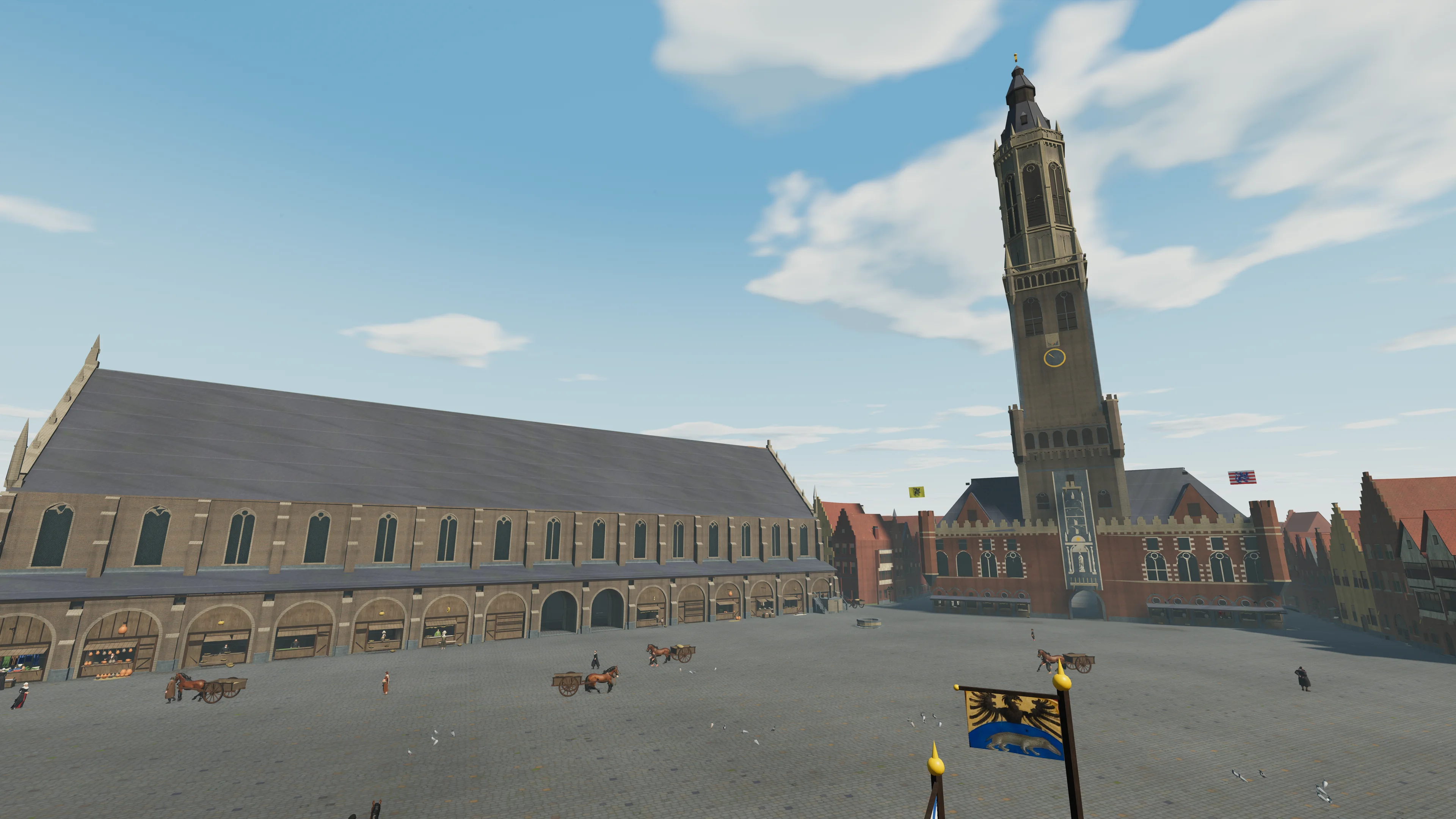
St Donatian’s Cathedral (Sint-Donaas)
The counts’ first church on the Burg was a round church built about 950 and burned in 1184. Its Romanesque successor was given a Gothic nave in 1331–1361. Jan van Eyck was buried here in 1441. In 1562 it had been the cathedral of the new diocese of Bruges since 1559, its crossing tower ruling the Burg, the canons’ cloister against its north side. It was sold in 1799 and pulled down by 1800; the cloister followed by 1801. Its foundations and the remains of its choir lie in the cellars of the hotel on the north side of the Burg. Sint-Donaas in Bruges 1562
The Waterhalle on the Markt
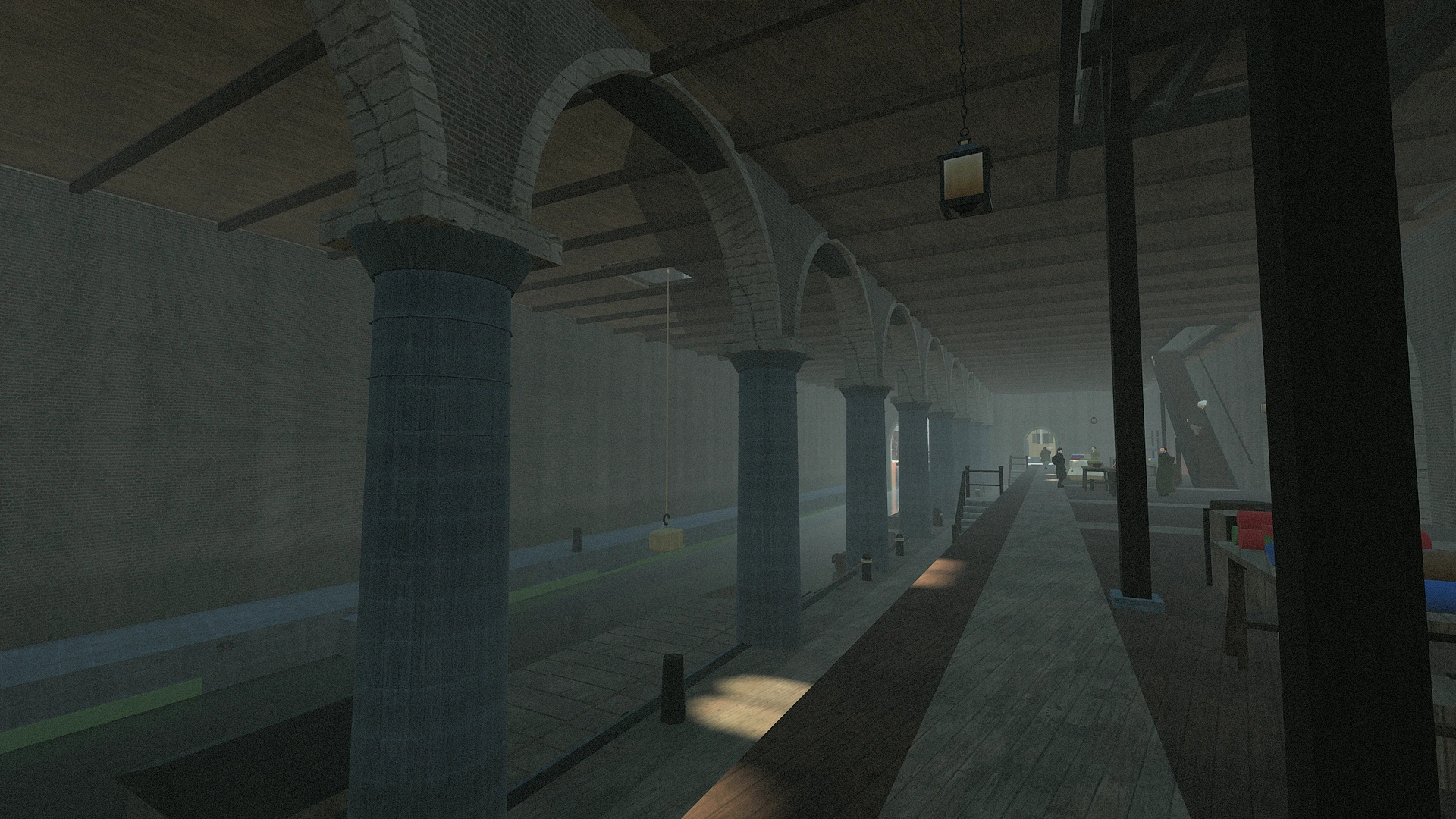
Built over the Kraanrei in 1283–1294, the Waterhalle let ships sail into the Markt. About 95 by 25 metres, it filled the east side of the square. In 1562 boats still passed beneath it, barges unloaded at a landing under its floor, and porters carried cloth and mercery up into its stores; small shops leaned against its front and the town’s pillory stood at its corner. It was demolished in 1787–1791, and the Kraanrei was filled in 1793–1795. The Provinciaal Hof stands on its site, and some of its Tournai-stone columns survive. The Waterhalle in Bruges 1562
Het Steen, the town prison
The counts’ stone house on the west of the Burg dates from about 1050. It became the counts’ prison in the late 12th century and the city prison in the late 13th. In 1562 it was still the prison: a long stone hall with a stepped gable, its back ranges rising straight from the Reie. A fire is recorded in 1689, and the ruin was demolished in 1785. Het Steen in Bruges 1562
The great crane
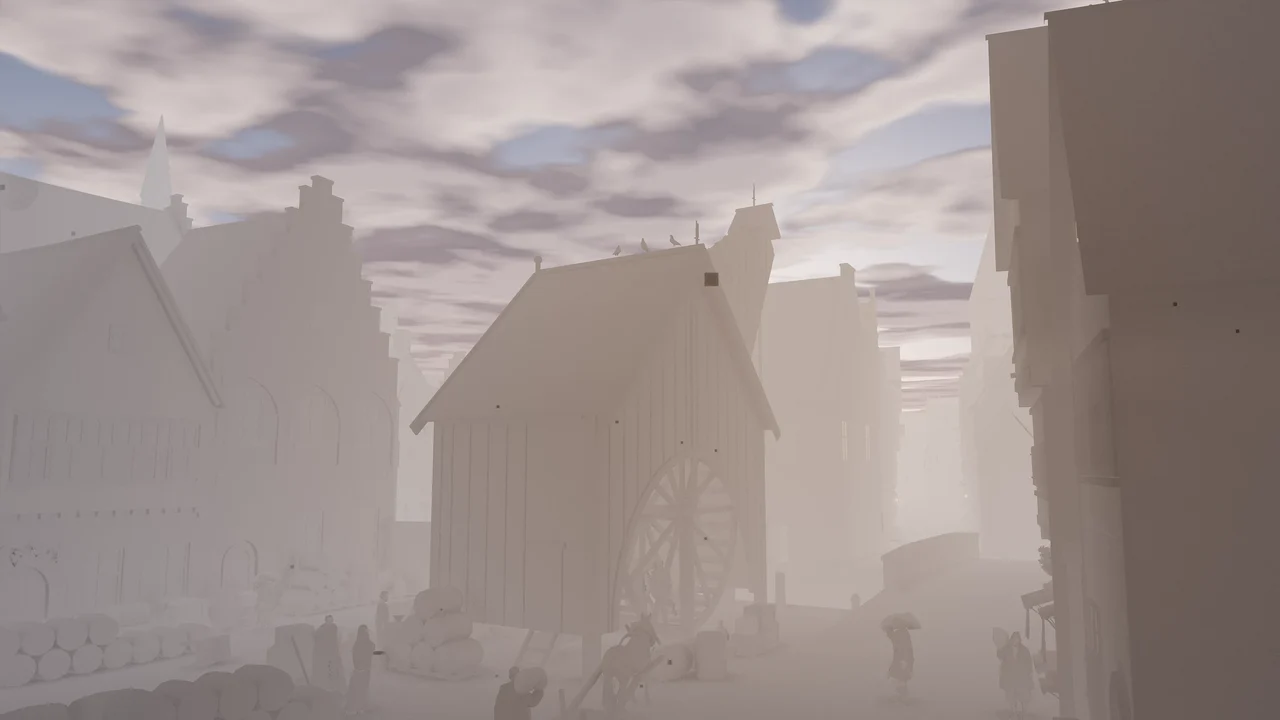
The city’s crane stood on the Kraanplein from about 1290 and was rebuilt several times; the one of 1562 dated from 1457–58. Men walking inside its treadwheels lifted wine and beer casks from the ships. It was replaced by a new crane in 1580–82, which was demolished at the end of 1767. The crane in Bruges 1562
Chapels on the Markt
The Sint-Kristoffelkapel, named in 1127, was the fishmongers’ chapel. In 1562 potters and butter dealers kept shops against its Markt side, under the chapel of St George. The chapels were pulled down in 1786; Markt 22–26 stands on their site. The Sint-Amandskapel, older than 1127, stood free in the Sint-Amandsstraat. The grocers kept it and the market women heard the first mass of the day there. It was sold at the end of the 18th century and demolished in 1817.
The Westvleeshuis
The butchers’ great meat hall was built in the first quarter of the 14th century. In 1562 it was a free-standing double hall of about 57 by 20 metres, its twin gables on the Steenstraat. The city bought and demolished it in 1819, and the Simon Stevinplein was laid out on its site. The Westvleeshuis in Bruges 1562
Two parish churches
The Sint-Janskerk was rebuilt almost entirely in late-Gothic form in 1430–34 and stood free in its square, with a tall spire on its west tower. The tower collapsed in 1611 and the church came down. The old Sint-Walburgakerk on the corner of the Riddersstraat became a parish church in 1239 and was enlarged into a three-aisled church in the 15th century. The old Jesuit church took over as parish church in 1778, and this one was demolished in 1781.
Friaries and an abbey
The Franciscans of the Minderbroeders friary settled in 1246; the Eekhout abbey grew in the 13th century. Both were dissolved and demolished in 1796; the Koningin Astridpark lies on much of the friars’ ground. The Augustinian friary held its block from 1314, with a long brick church on the water. It was sold and pulled down in 1813, and nothing of it stands above ground.
The mint and a bridge
In 1562 the moneyers of the Munthof struck King Philip’s silver daalders. The mint was abolished in 1786 and its buildings demolished in 1884 for the open Muntplein; its relief of 1563 is in the Gruuthusemuseum. The Sint-Jansbrug, rebuilt in stone with three arches in 1444, held a New Year market. It was demolished about 1787 and the Jan van Eyckplein laid out over it.
How they are rebuilt
A lost building cannot be measured. It is rebuilt from excavation plans, building accounts, written descriptions and old views, above all the map of Marcus Gerards of 1562. A picture gives the form; the size comes from what was measured. Every claim stands in a ledger with its sources, and what is a guess is said so. More on the method is on the page about the reconstruction.
See them standing again
In Bruges 1562 you walk past these buildings at eye height, in 3D, in your browser, and read a history card for each of the landmarks. It is free. You need a computer with Chrome or Edge. Join the waiting list to get in.
Questions
What happened to St Donatian’s Cathedral in Bruges?
It was sold in 1799 and pulled down by 1800. The Burgstraat was later laid over church and churchyard, and the remains of its choir lie in the cellars of the hotel on the north side of the Burg.
Where did the Waterhalle of Bruges stand?
On the east side of the Markt, over the Kraanrei canal. The Provinciaal Hof stands on its site today.
Can you still see anything of the lost buildings of Bruges?
A little: some Tournai-stone columns of the Waterhalle, the relief of 1563 from the mint in the Gruuthusemuseum, and Geldmuntstraat 30–32. A dig in 2020 found tracery of the Sint-Janskerk.
Which church is the cathedral of Bruges today?
The Sint-Salvator, cathedral of Bruges since 1834. In 1562 it was a parish church, and Sint-Donaas on the Burg was the cathedral.